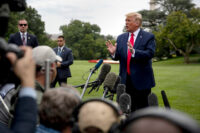




Washington - U.S. President George Bush urged Congress on Wednesday to authorize an additional $30 billion to fight AIDS in Africa over five years, according to Media reports.
The new founding would double what is currently being spent on AIDS in Africa.
The money would provide treatment for 2.5 million people under the President’s Emergency Program for AIDS Relief, White House press secretary Tony Snow said.
Through March 31, the program has supported treatment for 1.1 million people in 15 countries, including more than 1 million in Africa, Snow said. The program’s original five-year mandate, which called for spending $15 billion, expires in September 2008.
Snow said the specific goals for the next five years _ after Bush leaves office _ call for treatment of 2.5 million people, prevention of more than 12 million new infections and the care of more than 12 million people, including 5 million orphans and children.
The White House also announced that Bush’s wife, Laura, will visit four African countries _ Zambia, Mali, Mozambique and Senegal _ that have benefited from the U.S. program. The trip will take place June 25-29.
The president’s announcement comes before next week’s annual summit of industrialized nations in Heiligendamm, Germany. Germany is pledging to make Africa a central point and is calling for more aid, further debt relief and improved financial oversight.
Washington -The American Civil Liberties Union (ACLU) are planning to sue a Boeing subsidiary claiming the CIA transported 3 terrorist suspects overseas and tortured them during the flight.
According to the ACLU an Italian citizen, and Egyptian citizen and an Ethiopian were “mistreated” during their flights.
The three men are now prisoners in Guantanamo Bay, Morocco and Egypt respectively.
The lawsuit charges that the company (Jeppesen Dataplan) knowingly provided direct flight services to the CIA that enabled the clandestine transportation of the men to secret overseas locations.
“American corporations should not be profiting from a CIA rendition program that is unlawful and contrary to core American values,” said Anthony D. Romero, executive director of the ACLU. “Corporations that choose to participate in such activity can and should be held legally accountable.”
The suit claims they were tortured and subjected to other “forms of cruel, inhuman and degrading treatment.”
The ACLU said its lawsuit was being filed under the Alien Tort Statute, which permits aliens to bring claims in the United States for violations of the law of nations or a United States treaty. It said the statute recognizes international norms accepted among civilized nations that are violated by acts such as enforced disappearance, torture and other inhuman treatment.

Washington - US president George Bush has nominated former trade representative Robert Zoellick to replace Paul Wolfowitz as World Bank president. However, the Bank’s board has made noises that it may not sit quietly by and allow the Americans to appoint their man.
In a 29 May statement, the board prepared a profile of “key qualities for nominees to guide the selection process”. This included “a proven track record of leadership; experience managing large, international organisations, familiarity with the public sector and a willingness to tackle governance reform; a firm commitment to development; a commitment to and appreciation for multilateral cooperation, and political objectivity and independence”. The board has said that they expect “an intensive process of formal and informal consultation” on potential nominees, noting that nominations may be made by any executive director of the Bank. They have set a June 15 deadline for nominations, with a decision expected before Wolfowitz’ departure June 30.
If this threat to consider other nominees than that put forward by the US is made real, it would mark a substantial departure from the gentleman’s agreement which sees an American at the head of the Bank, and a European at the head of the IMF. In the week prior to the announcement, South Africa, China and Brazil were joined by Australia in open calls for an end to the leadership stitch-up.
It is widely believed that the Bush administration chose Zoellick because he is seen as more experienced in international diplomacy than other possible Republican loyalists. After a spell at the treasury and a stint as economics undersecretary of state in the 1980s, Zoellick turned in 2001 to act as George Bush’s first trade representative. During his four years in the job, he helped launch the Doha round of world trade talks and negotiations to bring China and Taiwan into the WTO. He moved to the state department before leaving government for investment firm Goldman Sachs and a job as managing director. Previously he served on the board of Enron, the world’s largest oil company.
However question marks are already being raised about both his management style, and his political leanings. Zoellick, 53, has been variously described as “hard-driving” and “a bit abrasive”. Nancy Birdsall, president of Washington thinktank, the Center for Global Development said: “The question is whether other countries will be satisfied that he is indeed the best candidate, for example, whether he has the right management skills.”
Politically, Mr Zoellick is closely aligned with the neo-conservatives. In 1998 he was a signatory to the Project for the New American Century, calling for increased military budgets and the ousting of Iraq’s Saddam Hussein. In Foreign Affairs magazine, he wrote: “A modern Republican foreign policy recognises that there is still evil in the world, people who hate America and the ideas for which it stands.”
During his time as chief US trade negotiator, Zoellick was notorious for bullying developing countries. In Behind the scenes at the WTO authors Fatoumata Jawara and Aileen Kwa, interviewed 34 trade ambassadors, negotiators and secretariat staff members. They provide an extensive catalogue of arm-twisting, pay-offs and abuse of process by the developed countries to force developing countries to sign up to an agenda they disagreed with, while ignoring the issues they had raised. The US, led by Zoellick, was the worst offender. This may explain the cool reception that Zoellick’s nomination has received from countries such as Brazil. According to Soren Ambrose of NGO SANA, “this is not someone who has made many friends in the developing world. This is someone who has asserted US prerogatives at every turn, has not shied away from insulting his counterparts, and who has had no visible qualms about tasks such as telling the West African countries no, the US will not give up its subsidies to multimillionaire cotton barons”.
Source brettonwoodsproject.org
Washington - US President George W Bush imposed new economic sanctions Tuesday on Sudan to help stop “genocide” in Darfur and said he would ask the United Nations to ban government military flights over the region.
Sudan’s government blasted the US and the United Nations, as the international body vowed to continue pursuing talks with Khartoum to end the Darfur conflict.
The US slapped sanctions on 30 companies, including five in Sudan’s booming oil industry, and froze the assets of two senior Sudanese government officials and a rebel leader whose group refused to sign last year’s Darfur peace agreement.
Also included is a company that has been transporting weapons to the Sudanese government and militia forces in Darfur, Bush said at the White House. The sanctions bar the companies and individuals from all business transactions through the US financial system.
“For too long, the people of Darfur have suffered at the hands of a government that is complicit in the bombing, murder, and rape of innocent civilians,” Bush said at the White House.
A Sudanese Foreign Ministry spokesman said the sanctions were unjustified, would heighten tensions between the two countries and “are not going to solve the problem of Darfur.”
“The government of Sudan is working with the UN and the African Union to reach a solution,” spokesman Ali Al-Sadig told Deutsche Presse-Agentur dpa.
UN Secretary General Ban Ki-Moon told reporters after Bush announced the sanctions that he plans to continue, in coordination with the African Union, to pursue talks with Khartoum to end the Darfur conflict.
Ban had asked Washington not to order new sanctions against the Sudanese government to allow diplomacy to work. He had been pushing for a two-track approach with intensified dialogue between Khartoum and the UN and AU and the formation of a joint UN-AU peacekeeping force of more than 20,000 troops to end the conflict in Darfur.
US diplomats will begin talks with Britain and other allies on a new UN Security Council resolution to tighten sanctions on the government of President Omar al-Bashir, including a ban on “offensive military flights over Darfur.”
“I call on President Bashir to stop his obstruction, and to allow the peacekeepers in, and to end the campaign of violence that continues to target innocent men, women and children,” Bush said.
The US move came ahead of next week’s Group of Eight summit in Germany, where Bush and seven other world leaders are expected to discuss Darfur.
Watchdog group Human Rights Watch called on the European Union to adopt similar sanctions following the G8 meeting, calling the US move “welcome but long overdue.”
The US accuses Sudan of obstructing the entry of UN peacekeepers into Darfur, where violence involving rebels and government-backed Arab militias, known as janjaweed, has left an estimated 300,000 people dead and more than 2 million displaced since 2003.
Under a November accord, Sudan’s government committed to allow a combined UN-AU force of more than 20,000 peacekeepers into Darfur. It would beef up a poorly equipped, 7,000-strong AU force policing an area roughly the size of France.
“They have stonewalled the implementation of this step by step. So we really haven’t made any progress,” Andrew Natsios, Bush’s special envoy for Sudan, told Cable News Network (CNN).
Bush threatened Sudan with sanctions in April, but agreed to hold off to give the UN more time to negotiate with Sudanese officials on the proposed deployment of a combined AU-UN force.
“President Bashir’s actions over the past few weeks follow a long pattern of promising cooperation while finding new methods for obstruction,” Bush said.
Sudan’s ambassador to the UN rejected the charges and blamed anti- government rebels in Darfur for the violence and bloodshed in the region.
Bashir “has not opposed anything,” but the international community needs to pressure rebel groups that have not signed the November accord, John Ukec Lueth told CNN.
In April, Sudan agreed to allow the first two phases of a UN deployment - some 3,000 UN peacekeepers and logistical staff.
Ban has also called for intensified humanitarian aid to people in Darfur who have suffered the most under the conflict, which has killed more than 300,000 people since 2003 and displaced more than 2 million refugees.
“I hope the international community can work in a mutually reinforcing way to bring peace and security in Darfur,” Ban said. He also urged Khartoum and rebel factions to meet international calls for ending the war.
Asked whether the new US sanctions would affect his work, Ban said, “We’ll have to see. What I can tell you at this time is I am doing my work as much as I can as secretary general.”
The Security Council had planned to send a delegation to Sudan in mid-June to review the situation.
Russia questioned Bush’s new sanctions, saying they differ from the overall strategy of the UN Security Council and Ban, which emphasize diplomacy and peacekeeping to end the ethnic conflict.
“To my mind it’s a departure from the current common strategy of the secretary general and the Security Council,” said Russian UN Ambassador Vitaly Churkin, noting that there has been “some encouraging progress.”
“If the overall strategy is changed, what is the role of the Security Council?” Vitaly asked, following a closed-door session of the 15-nation council.
French Ambassador Jean Marc de la Sabliere said the new US sanctions “may be necessary, may be they are not.”
“What we want is efficiency in the council, as much as possible,” he said. “It means working in consultations with other council members.”
The UN last year imposed an arms and travel sanctions against Sudan, but those measures had not been fully implemented.
Targeted by the US sanctions were Ahmad Muhammed Harun, Sudan’s state minister for humanitarian affairs, who has been accused of war crimes by the International Criminal Court in the Netherlands.
Also placed under sanctions was Sudan’s chief of military intelligence and security, Awad Ibn Auf, along with Khalil Ibrahim, leader of the Justice and Equality Movement (JEM), a rebel group that refused to sign the November peace deal.
China, which has growing oil interests in Sudan to fuel its booming economy, will be key to any new UN sanctions.
Beijing said before the US move was announced that it would oppose more sanctions against Sudan and defend its cooperation in oil exploitation with the Sudanese government.
“If you only put pressure on Sudan, it is not helpful to resolving the issue [of Darfur]; it can only make the issue more complicated,” said Liu Guijin, a special envoy to Sudan for Chinese President Hu Jintao.
Washington - U.S. activist Cindy Sheehan, whose protests against the Iraq war has drawn widespread attention and criticism is quitting her public role, saying that the US was becoming a “fascist corporate wasteland” facilitated by a two-party system in which both parties were equally to blame.
Here are some vistor comments regarding her annoucement:
All I can wish for Cindy Sheehan is that she can find the peace and meaning that is so hard to come by for parents of dead children. To read her saying, “Casey did die for nothing,” drives home the enormity of her loss and reminds us that, after all, she is a grieving mother first and foremost.
Her criticism about support for her cause is apt - as soon as she expanded the scope of her criticism from the Republicans to include the system in general then all of a sudden she wasn’t the left’s darling any more. It points to the bigger issue of partisan politics in the U.S. and how entrenched people are in their positions.
Comment by Maria E. Andreu
It’s about time that she realize that what she needed to do was be with her family and not trying to change the president mind which is already made up. and she just lost more love ones instead of gaining more.
Comment by Eddie
While I am anti-war in Iraq, I have to say this poor lady needs help. It has always been with her: if you don’t totally agree with me, you are totally wrong and without values. After 9/11, there are a lot of grays out there and people realize it. It is militant terrorists under the Islam banner against everyone else–including their own people. What I hate to see more than anything is what this is doing to the Iraqi people. After Saddam, they don’t deserve it.
Comment by M L Parker
Cindy has it right! IF the number of the military killed & maimed even came close to that in Veitnam there would be an uproar in this country. There aren’t enough people that give a damn about this war. No one of note has had to be put in harms way. In that case the wealthy would be put at risk. That would be a different story. Good luck Cindy.
Comment by William Gleason
Maybe instead of trying to stop the war, Sheehan should have run for a political office at the national level. She could have done much more. I would have voted for her. Sheehan is correct. America is not America any more. It’s a third world country with nuclear capabilities.
Comment by J.A. Clark
[Her son] did not die for nothing he died protecting this country .Thank god for all the men and women over there fighting for this wonderful country…
Comment by mike
Start the draft and watch the peace movement take off. She is right the general population is not concerned enough to do any thing but watch TV and go to work, one would think that double gas prices would do something. To all of you couch creatures buy your gas from small independents not the majors and that will do something, without you having to spend to much energy.
Comment by duke mcclain
Sheehan suffered a great loss and unfortunately that fed her uncompromising view of the war in terms that did not allow her to see beyond her immediate tragedy. Few individuals are “for” war, but the question rests on determining if there was a perceived “value added” when the war started. The country’s safety is a president’s over-riding responsibility. If Sheehan felt that politics was a greater motivation then she had a valid point. Problem is that politics seems to infect the Democratic party equally and thus the dilemma of identifying an honest broker whose motivations are untarnished. The realization must have added to her pain.
Comment by Bud
Washington - Tuesday at Federal Law Enforcement Training Center (FLETC), located just outside of the city of Brunswick, President George W. Bush made it clear that he was not going to stop fighting for the proposed immigration reform bill, which would allow illegal immigrants with no criminal records to register to remain temporarily in the United States after paying a fine.
“A lot of Americans are skeptical about immigration reform primarily because they don’t think the government can fix the problems,” Bush stated. “And my answer to the skeptics is, give us a chance to fix the problems in a comprehensive way that enforces our border and treats people with decency and respect.”
President Bush followed this up with the following statement:
“[The bill] is the best hope for lasting reform. If people are interested in fixing a system that’s broken, this bill is the best hope to do so.”
Georgia senators Saxby Chambliss and Johnny Isakson, both Republican, approve of the current bill, although they did say they may not support the final bill, depending on how it is amended.
Along with giving a select amount of illegal immigrants temporary occupancy, the bill would also create a guest worker program which would allow foreign laborers to come to the United States temporarily.
Still, even if the illegal immigrants gained temporary citizenship, to obtain a green card, they would have to learn English, pay yet another fine, and return to their home country…to wait in line.
Washington (eCanadaNow) - US health officials warned Tuesday that passengers on two international flights may have been exposed to an extensively drug-resistant strain of tuberculosis.
The US Centres for Disease Control (CDC) said a US citizen infected with the lung disease travelled on an Air France flight from Atlanta, Georgia to Paris on May 12 and then on a Czech Air flight from Prague to Montreal on May 24.
The CDC said the passenger has been identified and been quarantined through a rare federal order signed by President George W Bush. The federal government has the authority to quarantine people suffering from eight specific diseases, but has not done so for more than 40 years, CNN reported.
CDC Director Julie Gerberding said at a televised press conference that the patient would remain in isolation until he was no longer infectious.
Passengers sitting near the infected passenger and crew members were urged to be tested for the disease.
San Francisco - Cindy Sheehan, the bereaved mother whose anguished protests pioneered the US anti-war movement, is quitting her public role, saying that the US was becoming a “fascist corporate wasteland” facilitated by a two-party system in which both parties were equally to blame.
Sheehan announced the move in a letter posted on her weblog. On Tuesday she left the protest camp she purchased outside President George W Bush’s ranch in Crawford, Texas, and headed home to California to be with her family.
“I am going to go home and be a mother to my surviving children and try to regain some of what I have lost,” she wrote.
The move came just days after the Democrats backed down from a war-funding bill that would have placed a timeline on US withdrawal from Iraq. The move was widely seen as capitulation to Bush and sparked widespread anger in the anti-war movement.
“I was the darling of the so-called left as long as I limited my protests to George Bush and the Republican Party,” Sheehan wrote. “When I started to hold the Democratic Party to the same standards that I held the Republican Party, support for my cause started to erode. I guess no one paid attention to me when I said that the issue of peace and people dying for no reason is not a matter of ‘right or left’, but ‘right and wrong’.”
Sheehan also blasted the peace movement for its petty infighting, and argued that the country as a whole appeared unready to take the steps needed for peace.
Sheehan started protesting the war in June 2004, following a meeting with Bush three months after her son Casey died. As a bereaved mother, her criticism garnered worldwide attention and became a focal point as discontent with the war grew.
But in her emotional resignation letter, Sheehan said the toll of the protest had overwhelmed her personally, politically and financially, draining all her savings, destroying her 29-year marriage and leaving her other children without a mother close by.
“Casey did indeed die for nothing … killed by his own country which is beholden to and run by a war machine that even controls what we think. Casey died for a country which cares more about who will be the next American Idol than how many people will be killed in the next few months.
“I have invested everything I have into trying to bring peace with justice to a country that wants neither,” she wrote. “Good-bye America … you are not the country that I love and I finally realized no matter how much I sacrifice, I can’t make you be that country unless you want it. It’s up to you now.”
Baghdad - Five British citizens have been seized in the Iraqi capital, Baghdad, according to media reports Tuesday.
The group, comprising a finance expert and four bodyguards, were captured from the finance ministry by kidnappers wearing police uniforms and driving police vehicles. It is reported that over 40 police vehicles were involved in the incident.
In separate incidents, at least 22 people were killed and 55 injured in a bus explosion elsewhere in the city, and at least 15 people were killed in a car bomb which injured a further 36, possibly more.
It is believed the four bodyguards are employed by Canadian company Garda
Washington - In disappointment, in disgust, in dejection, Cindy Sheehan announced today that she’s packing up and going home.
After her son Casey was killed in the war in Iraq, Cindy set up camp in Crawford, Texas down the road from the Bush “ranch” to protest the war.
She demanded to see and talk to the President regarding the war, but was unsurprisingly rebuffed and ignored.
Sheehan, 49, of Vacaville, Calif., stood her ground and fought the good fight, founded an organization called Gold Star Families for Peace.
In announcing her decision in a statement released to the liberal blog Daily Kos, Sheehan said the protest had taken an enormous physical and emotional toll on her.
“I have used all my energy trying to stop this country from slaughtering innocent human beings. I have been called every despicable name that small minds can think of and have had my life threatened many times,” Sheehan said.
Fueling Sheehan’s decision to end her public protest was frustration with national politics as well her unsuccessful attempts to work “within a peace movement that often puts personal egos above peace and human life.”